
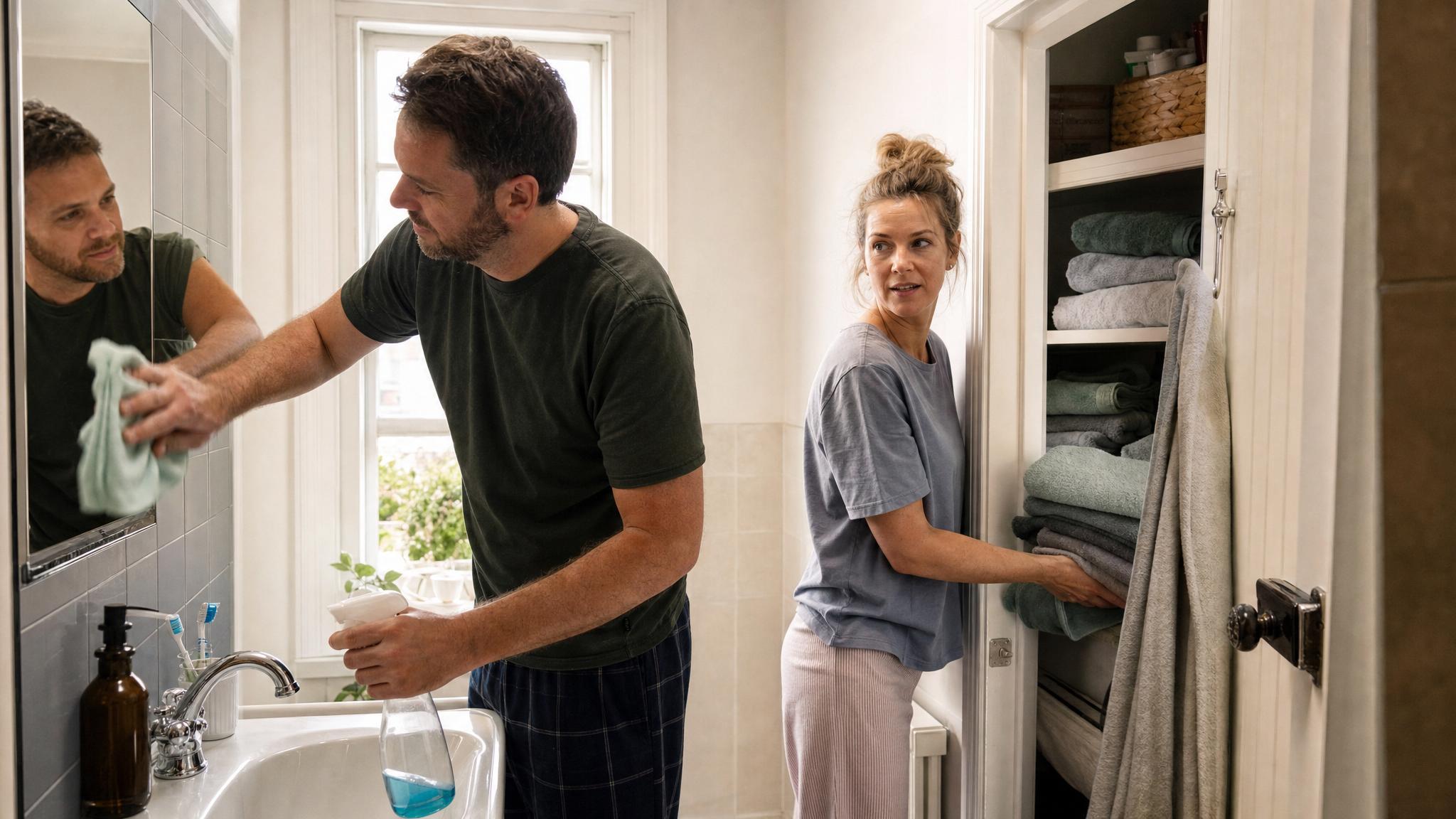
A chore rota app for couples can sound overly formal until the same jobs keep causing the same argument. Someone notices the towels, bins, dishes, bathroom sink, and empty fridge first, while someone else only sees the jobs after they have already become a problem.
Housemates run into the same thing. If the rota lives in a WhatsApp thread, a fading fridge note, or one person’s memory, the actual work still feels uneven.
Duety helps shared homes turn that messy mental rota into something visible. Instead of arguing about who “always” does more, everyone can see what needs doing, what has been done, and whether the split is fair by effort.
Why Shared Chores Become So Frustrating
Chore arguments rarely start with one plate in the sink. They build because household work is repetitive, easy to miss, and often noticed only when it has not been done.
Time-use data shows why this matters. In the UK, women spent an average of 3 hours and 32 minutes per day on unpaid work including housework, care, and volunteering in March 2024, according to NatCen’s summary of ONS Time Use Study data. That was 57 minutes more per day than men, who averaged 2 hours and 35 minutes. Source
Irish research points in the same direction. ESRI time-use analysis found that women in Ireland spent more time on caring and housework, while men spent more time on paid work. When paid work, unpaid work, and travel were combined, women worked around 40 minutes longer per day on average, controlling for other factors. Source
This is not about turning chores into a gender battle. It is about making invisible, unmeasured effort visible enough to share. The same problem shows up in couples, families, and shared flats: if the system depends on one person noticing everything, that person becomes the household manager by default.
What a Chore Rota App for Couples Should Actually Do
A useful chore rota app for couples should do more than assign Monday bins and Tuesday bathroom cleaning. It should make responsibility clear without adding admin.
The first job is visibility. Everyone needs one shared place to see recurring jobs, completed jobs, and upcoming tasks.
The second job is ownership. “Help more” is hard to act on. “You own towels and bathroom supplies this week, I own bins and the kitchen reset” is clearer. Ownership means noticing, doing, and marking the job complete.
The third job is fairness. Counting tasks can look balanced while still feeling unfair. Emptying a small bin and deep-cleaning a bathroom are both one task, but not the same work.
That is where Duety’s Fairness Meter matters. Duety weights chores by effort, so the split reflects what the jobs actually take. A home can stop chasing a perfect 50/50 task count and start looking at whether the real workload feels balanced.
A Better Rota for Housemates
Housemates often need a slightly different rota from couples. The relationship stakes are different, but the friction can be just as real: bins ignored, bathrooms left for the same person, and shared spaces becoming nobody’s responsibility.
For a shared flat, start with the jobs that affect everyone. Bins, recycling, bathroom cleaning, kitchen surfaces, floors, shared supplies, and fridge clear-outs should all be visible.
Then separate rota jobs from personal jobs. Your own bedroom, laundry, and private mess are different from the shared bathroom or kitchen. A good household jobs app keeps the shared work obvious.
Finally, rotate the unpleasant jobs fairly. If one housemate always gets the bathroom and another always gets the easier reset tasks, the rota might look organised while still being unfair. Effort points make that imbalance easier to spot.
How Duety Keeps Shared Chores Practical
Duety is built for households that want fairness without constant negotiation. You add the jobs your home actually needs, assign them, and track what gets completed.
For couples, that might mean seeing the recurring effort behind bins, dishes, towels, bedsheets, and bathroom cleaning. For housemates, it can mean replacing “someone should do it” with clear shared ownership.
The point is not to keep score forever. The point is to stop relying on tired conversations and selective memory. When chores are visible, it is easier to say, “this week is uneven” without turning it into a personal accusation.
If you want the UK and Ireland angle, read Duety’s guide to a chore rota app for splitting household jobs. If you are comparing options broadly, the guide to the best chore app for couples in 2026 explains what to look for.
Try This Shared Chores UK Setup This Week
Start with a ten-minute reset. List every shared job that happens daily, weekly, or occasionally. Include the obvious jobs, plus the ones people forget: replacing towels, restocking toilet roll, taking bins out before collection day, and clearing the fridge.
Next, give each job an owner for the week. The owner is responsible for noticing and completing the job, not waiting to be asked.
Then weight the jobs by effort. Quick jobs can be low effort. Bathroom cleaning, changing bedsheets, and a full kitchen reset should count for more. This is the difference between a rota that looks equal and a rota that feels fair.
Review it once a week. Ask what was forgotten, what felt annoying, and whether anyone carried too much invisible work.
The Biggest Mistake to Avoid
Do not build a rota that depends on one person maintaining the rota.
That is the trap many shared homes fall into. The system looks organised, but one person still adds the jobs, reminds everyone, checks whether they were done, and absorbs the frustration when they were not.
A chore rota app for couples and housemates should reduce that admin, not disguise it. The app should hold the reminders, the records, and the fairness view, so responsibility is shared instead of managed by one person.
FAQs about chore rota apps for couples and housemates
What is a chore rota app for couples and housemates?
A chore rota app for couples and housemates is a shared tool that makes recurring household jobs visible, assigns clear ownership, and helps everyone see whether the workload is fairly split across the people sharing a home.
How do housemates split chores without it getting awkward?
Housemates split chores more easily when the jobs are written down, ownership is clear, and rotation is fair. A visible rota removes the need for awkward reminders because the app shows what is due and who is responsible, instead of one person always having to ask.
What features should a shared household rota app include?
A shared household rota app should include recurring chores, clear ownership, completion tracking, and a way to rotate unpleasant jobs. It should also separate shared-space jobs from personal ones so a flatmate’s own laundry or bedroom is distinct from the bathroom or kitchen everyone uses.
Is a chore rota app better than a WhatsApp group or fridge list?
A WhatsApp group or fridge list can work for a while, but a chore rota app is better when jobs repeat, need reminders, and the same person keeps being the one who notices. A purpose-built app tracks completion, rotates jobs automatically, and shows the balance over time instead of relying on someone to update a note.
How does Duety make shared chores fairer?
Duety weights chores by effort so that harder jobs count for more. Its Fairness Meter shows everyone whether the household workload is balanced, making it easier to spot and fix an uneven split before it causes resentment.
Make the Rota Visible
Fair chores are not about doing the exact same number of tasks. They are about recognising the effort behind the home and sharing that effort in a way everyone can see.
Duety helps couples, families, and housemates create a calmer system for shared chores. Add your jobs, track completion, and use the Fairness Meter to see whether the split is actually balanced.
Download Duety on Google Play and start building a fairer shared rota today.