

If you are always the one who notices the overflowing bin, the sticky counter, the school bag by the door, or the sheets that need changing, the chore gap stops feeling like a statistic. It starts feeling like proof that your time, attention, and rest are not being counted.
That is why the chore gap matters: not because one person is the villain, but because invisible effort turns into resentment when nobody measures it. The fix starts by making the work visible, then using a fairer system to split chores fairly across couples, families, and roommates.
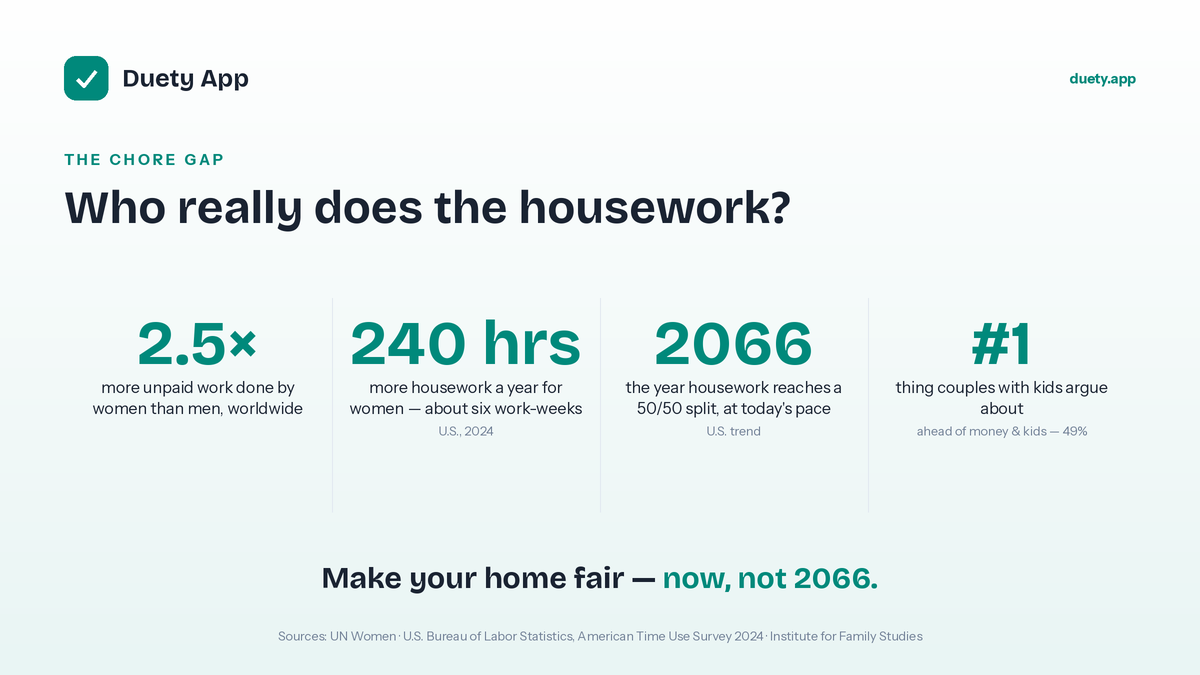
The chore gap is real, and global
Globally, women do at least 2.5 times more unpaid care and domestic work than men, according to UN Women. That includes the obvious jobs, like cooking and cleaning, but also care work, planning, organising, and keeping a household running.
UN Women Data Hub also reports that women spend 2.8 more hours per day than men on unpaid care and domestic work. The exact size of the chore gap varies by country, income, family type, and paid work pattern, but the direction is remarkably consistent.
For Duety’s main markets, the global figure can sound too broad. A useful developed-country benchmark from Jacques Charmes’ ILO analysis is that women do about 65% of unpaid work in developed countries, compared with roughly 76% globally.
The daily gap does not sound huge until you add it up
In the United States, the 2024 American Time Use Survey found that women averaged 2.34 hours per day on household activities, while men averaged 1.67 hours, according to BLS household activity data. That is about 40 minutes more per day.
Forty minutes can sound small in one conversation. Added up across a year, the daily gap is roughly 240 extra hours, or about six 40-hour work-weeks of housework.
That annual figure is an annualisation of the daily average, not a separate published BLS statistic. It matters because the chore gap often feels like a series of tiny moments: wiping the counter, remembering the laundry, noticing there is no milk, or resetting the kitchen after everyone else has moved on.
It is closing, but glacially
The picture is not all bad. A 2024 NBC News analysis of BLS American Time Use Survey data found that men are doing more housework than before, reaching a record of about 100 minutes per day in 2024.
That deserves credit. More men are participating in the work of running a home, and many couples genuinely want a fairer split than the one they saw growing up.
But NBC’s analysis also found that women did about 40 minutes more housework per day in 2024, down from about 60 minutes more in 2003. At that pace, a 50/50 split in housework would not arrive until around 2066.
The chore gap is also a mental load gap
The time gap is only part of the story. The mental load is the remembering, noticing, planning, and following up that makes a home function before a task becomes urgent.
The 2024 BLS American Time Use Survey summary found that 87% of women and 74% of men did some household activity on an average day. BLS household activity tables also show women averaged more time on interior cleaning, 0.55 versus 0.25 hours, and laundry, 0.24 versus 0.08 hours, than men.
That split matters because repeated, predictable tasks are the ones most likely to disappear into the background. If one person always knows when the bathroom needs cleaning, when school clothes need washing, or when dinner supplies are running low, they are carrying more than the visible task.
Chores are what couples with kids fight about most
Household work would be easier to ignore if it stayed practical and unemotional. It does not.
An Institute for Family Studies analysis of couples with kindergarten-age children found that chores and responsibilities were the most common argument topic. Forty-nine percent argued about them, ahead of money at 43% and the children at 41%.
That does not mean every household fight is really about chores. It means chores are often where deeper questions show up: Am I seen? Is my time respected? Are we both contributing to the life we share?
How to close the gap at home
The goal is not to turn your relationship into a spreadsheet. The goal is to stop relying on memory, mood, and vague impressions when the work can be made visible.
Start by listing all recurring tasks, including invisible ones. Include cleaning, cooking, bins, laundry, admin, shopping, pet care, childcare logistics, and the small reset jobs that usually happen between bigger tasks.
Then weight the work by effort, not just count. Taking out the bins and deep-cleaning the bathroom are both one task, but they are not the same load.
Make the split visible somewhere both people can see it. A shared note is better than guessing, but a purpose-built tool like Duety goes further by tracking who did what and showing the balance over time.
Review the split regularly, especially after a schedule change, a new baby, a move, a busy work season, or exams. Fairness is easier to maintain when it is a normal check-in rather than a crisis conversation.
Duety’s Fairness Meter is built around effort-weighted chores, not just task count. That is the part that matters if you want to close the chore gap in a way that feels fair in real life.
For more practical setup ideas, read Duety’s guide on how to split chores fairly when you both feel busy, or compare what a chore app that tracks who did what can show that memory usually misses. If you want the broader app comparison, start with our best chore app for couples in 2026 guide.
Make your home fair now, not in 2066
The data is clear: the chore gap is real, it is shrinking slowly, and it causes more friction at home than many people expect. But your household does not have to wait for a generational trend line to catch up.
Fairness gets easier when the work is named, weighted, tracked, and reviewed. Once the invisible becomes visible, the conversation changes from “you never help” to “what needs rebalancing?”
That shift is small, but it is practical. Most homes do not need a perfect 50/50 split every single day; they need a shared system that catches imbalance before it becomes resentment or another tired Sunday argument.
FAQs about the chore gap
What is the chore gap?
The chore gap is the difference between how much household work each person does, including visible tasks like cleaning and invisible work like noticing, planning, and reminding.
Who usually does more housework?
Research often finds that women still do more unpaid household work on average, but the useful lesson for any home is to measure the real workload instead of relying on assumptions.
Why does the chore gap cause arguments?
The chore gap causes arguments because housework is tied to time, rest, respect, and whether both people feel supported. When the work is invisible, it is easier for both partners to feel misunderstood.
How can couples measure chore fairness?
Couples can measure chore fairness by tracking what gets done, who owns each task, and how much effort each chore takes. Effort matters because not every task carries the same weight.
How can Duety help close the chore gap?
Duety helps make household work visible. The Fairness Meter shows whether chores are balanced by effort, making it easier to fix an unfair pattern before it becomes resentment.
Download Duety
Ready to split chores fairly? Download Duety free on Google Play and start building a calmer household routine together. Duety includes a free plan, and the Premium Fairness Meter weighs effort rather than just counting tasks, with a 14-day Premium trial available.